Hostage Negotiations at the Front Door: Why Leaving Someone's House Takes Longer Than Your Actual Visit
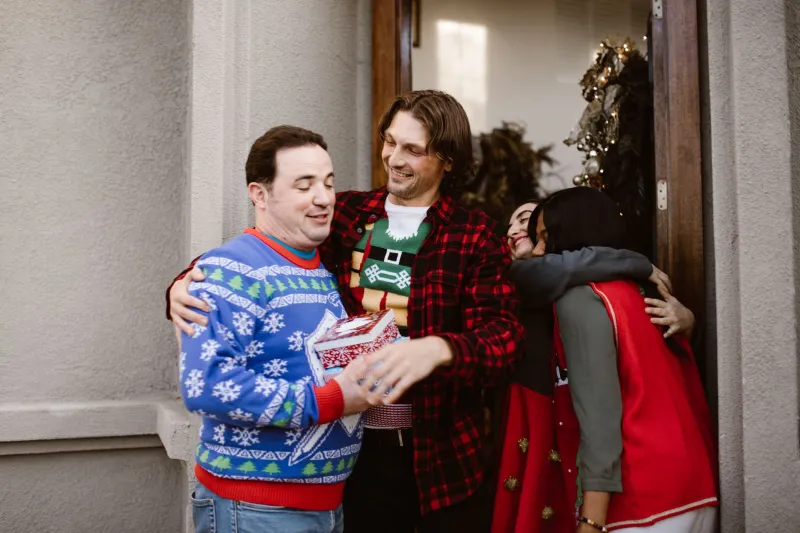
Hostage Negotiations at the Front Door: Why Leaving Someone's House Takes Longer Than Your Actual Visit
It starts so innocently. You glance at your phone, notice it's getting late, and decide to be a responsible adult. You set down your drink, smile warmly, and deliver the opening line of what you believe will be a clean, dignified exit: "Okay, we really should get going."
That was forty-five minutes ago. You are still here. You have not moved. In fact, somehow you are now sitting back down on the couch holding a fresh glass of water that nobody asked for but everyone accepted without question. The evening has entered a second act that no one planned, and the front door — which is literally six feet away — might as well be in another zip code.
Welcome to the most inexplicable ritual in American social life: the departure ceremony. It has no agenda, no defined endpoint, and no known cure.
Act One: The False Start
The first goodbye is purely ceremonial. Both parties know this. You say it anyway because it has to be said, like the opening credits of a movie nobody's actually watching yet.
You stand up. Your host stands up. There is a warmth, a brief summary of how much fun tonight was, a mutual acknowledgment that yes, you really do need to do this more often. Coats are located. Keys are jangled. Everything points toward departure.
And then — and this is the precise moment the invisible force field activates — someone says, "Oh, but before you go..."
It could be anything. A funny story. A recommendation for a show. A brief update on a mutual friend that somehow expands into a twenty-minute biography. The content is irrelevant. The function is clear: the door has been spiritually closed from the inside, and you are not going anywhere.
You sit back down. You don't even think about it. Your body just does it, because your body has been through this before and knows the rules.
Act Two: The Driveway Extension
Eventually — through sheer collective willpower and a second round of coat-locating — you make it outside. The night air hits you. Freedom feels close. You can practically see your couch at home, your pajamas, the leftover pizza you've been thinking about since 9 PM.
And then the driveway conversation begins.
Nobody initiated it. It simply emerged, the way fog emerges — formless, unavoidable, impossible to walk through quickly. You are now standing next to your car, keys in hand, discussing something that absolutely could have been texted later. But here you are. Feet planted on concrete. Going nowhere.
The driveway phase is particularly dangerous because it feels like progress. You're outside. You're near the vehicle. Technically, you have left the house. But physically departing and actually leaving are two completely different disciplines, and you have only mastered the first one.
Minutes pass. The conversation takes a turn, finds a second wind, introduces a subplot. Someone brings up a memory. Someone else laughs louder than expected. Now you're having a moment, and you can't leave during a moment. That would be socially barbaric.
Act Three: The Car Window Finale
You are in the car. This should be the end. This is never the end.
The window goes down — either because you rolled it down deliberately to say one last thing, or because your host walked over and you panicked and rolled it down reflexively, like a dog recognizing a leash — and now you are conducting the third and final movement of this symphony through a rectangle of open glass.
The car window goodbye has its own internal logic. It's shorter than the driveway conversation but somehow more emotionally dense. Things get said here. Real things. Heartfelt things. Plans get made, promises get renewed, a story gets started that will definitely not be finished before someone finally drives away.
You will wave. They will wave. You will begin to pull out. They will say one more thing. You will stop the car. This will happen between two and four times before the actual departure occurs.
Why Does This Keep Happening
Here's the uncomfortable truth: nobody actually wants to leave. The goodbye ritual exists because the visit was good, the company was warm, and the real world waiting at home is considerably less fun than standing in a driveway talking about nothing in particular with people you genuinely like.
Every extended farewell is just affection wearing a trench coat, pretending to be an exit strategy.
That doesn't make it any less absurd. You could have been home an hour ago. You could be horizontal right now. Instead, you are standing on a suburban driveway at 11:30 PM, one hand on your car door, laughing at something you'll struggle to remember tomorrow.
And honestly? You wouldn't change a thing. You'll just blame the traffic when you get home.
Next time, though — next time you're leaving on time.
(You're not.)