The Diplomatic Crisis That Erupts When Four Friends Try to Pay for One Meal
It seemed so innocent at first. "Let's grab dinner!" someone suggested, and everyone agreed because you're all adults with jobs and credit cards and the basic ability to purchase food together like civilized humans.
What could possibly go wrong?
Everything. Everything could go wrong. What follows is a detailed account of how four reasonable people can turn a pleasant meal into a mathematical nightmare that would make a CPA weep.
The Deceptively Simple Beginning
The trouble starts before you even order. Sarah announces she's "not super hungry" and will probably just get an appetizer. Mike declares he's doing keto, so no bread, no sides, just protein. Jessica mentions she had a late lunch but will "definitely get something small." You, meanwhile, are starving and plan to order like a normal human being.
Already, the bill-splitting algorithm is getting complicated, but nobody acknowledges this yet. You're all still operating under the naive assumption that you'll just "figure it out later."
Famous last words.
The Ordering Olympics Begin
Sarah, who claimed she wasn't hungry, orders the salmon, a side salad, and asks if the appetizer hummus can be made into a full-size portion. Mike gets the ribeye steak (the most expensive item on the menu) but substitutes every single side dish. Jessica orders soup, then adds bread, then decides she wants the pasta after all, "but can I get it as a half portion?"
You order a burger and fries like some kind of amateur.
The waiter, who has clearly seen this movie before, asks the fatal question: "Will this be together or separate checks?"
Four voices respond simultaneously: "Together!" "Separate!" "Whatever's easier!" "I don't care!"
The waiter's smile becomes strained. They scribble something that looks like hieroglyphics on their notepad and disappear, probably to update their resume.
The Drinks Situation Escalates
Halfway through dinner, Mike remembers he bought the first round of drinks at the bar while you were waiting for your table. This information arrives like a hand grenade thrown into an already tense situation.
"Oh, but I got everyone's drinks earlier," he mentions casually, as if this detail isn't about to transform dinner into advanced calculus.
Suddenly, everyone's trying to remember what they drank. Sarah had wine, but was it one glass or two? Jessica switched from wine to water after the first glass, but then had a coffee. You had two beers, but one was during happy hour pricing, which may or may not apply to tabs that were started before 5 PM but continued after.
Mike waves his hand magnanimously. "Don't worry about it, it wasn't that much."
This gesture, meant to be generous, actually makes everything worse. Now there's debt floating in the air that nobody can quantify. The social mathematics have become quantum physics.
The Bill Arrives: A Document of Mass Confusion
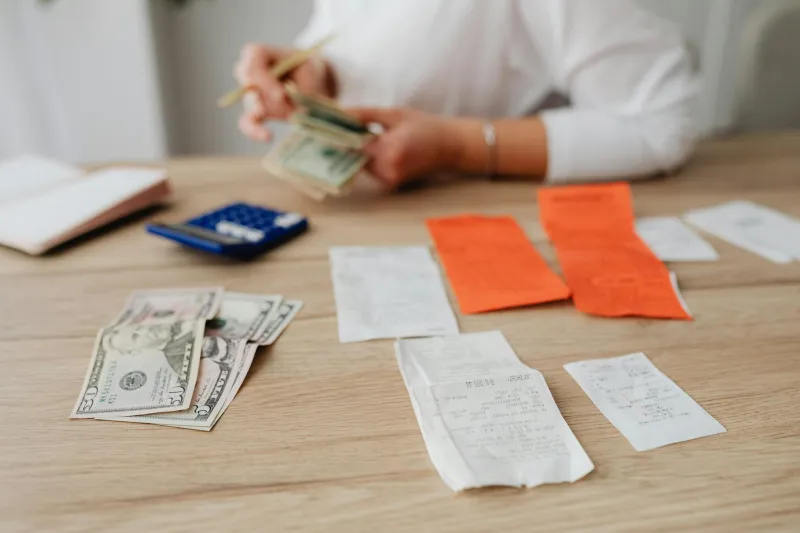
The check finally appears, and it looks like it was printed in ancient Sanskrit. There are charges for things nobody remembers ordering. A "kitchen surcharge." Tax that seems suspiciously high. A 20% service charge that may or may not be the tip.
Sarah immediately pulls out her phone calculator. Jessica starts photographing the receipt like she's documenting evidence at a crime scene. Mike announces he has cash, which somehow makes everything more complicated rather than less.
You stare at the total and try to do quick mental math, but your brain has apparently forgotten how numbers work.
The Great Calculator Convergence
Now everyone has their phones out, running different calculations based on different theories of fair distribution.
Sarah's approach: Everyone pays for exactly what they ordered, plus their portion of tax and tip, calculated to the penny.
Jessica's method: Split everything evenly four ways because "it's easier and we're friends."
Mike's strategy: He'll cover the drinks he bought earlier, plus his meal, plus extra for tip because he's "feeling generous tonight."
Your system: Panic math. Just divide the total by four and hope for the best.
Four different calculations yield four wildly different results. Someone's math is definitely wrong, but nobody wants to be the person who challenges anyone else's arithmetic skills.
The Venmo Standoff
Jessica suggests everyone Venmo her, and she'll put the whole thing on her card. This seems reasonable until the Venmo requests start flying.
Sarah sends Jessica $23.47. Mike sends $31.20. You send $25.00 because round numbers feel safer. Jessica realizes she's somehow short $18, but can't figure out where the discrepancy came from.
More calculator sessions ensue. Someone suggests adding another dollar each "just to be safe." Mike offers to cover the difference, which makes everyone feel guilty. Sarah insists on recalculating everything from scratch.
The waiter returns three times to ask if you need anything else, clearly wanting to close out your table so the next group of mathematical disasters can sit down.
The Cash Wildcard
Just when you think you've reached a solution, Mike pulls out his wallet and produces exact change in what appears to be mostly quarters and dollar bills. "I've got cash," he announces, as if this solves everything rather than introducing an entirely new variable into an already unstable equation.
Now you need to factor in cash back, who has change, and whether the tip should be calculated on the pre-tax amount or the total. Jessica doesn't have cash to give Mike change. Sarah only has a twenty-dollar bill. You have three crumpled singles and some lint.
The payment situation has devolved into something resembling a hostage negotiation.
The Guilty Resolution
Finally, after forty-five minutes of mathematical torture, someone just overpays significantly to end the suffering. Usually it's the person who ordered the least expensive item, because guilt is apparently inversely proportional to how much you actually owe.
Everyone leaves feeling vaguely unsatisfied with the financial arrangement, but too emotionally exhausted to continue the discussion. You all promise to get separate checks next time, knowing full well that you'll forget this promise by the next dinner invitation.
The Uncomfortable Truth
The most absurd part of this entire ordeal? The actual difference between splitting evenly and calculating individual portions is usually less than five dollars per person. You've just spent more time, energy, and emotional labor on bill division than most people spend planning their retirement.
Yet somehow, we continue to turn simple arithmetic into complex social theater, transforming friendly dinners into inadvertent tests of mathematical ability and social diplomacy.
Next time someone suggests dinner, maybe just meet at a food truck. At least then you can pay separately without needing a degree in accounting and a minor in conflict resolution.
Because apparently, splitting a restaurant bill has become more complicated than filing taxes, and significantly more stressful than most actual diplomatic crises.