Welcome to the Grocery Store Thunderdome: Where Common Courtesy Goes to Die
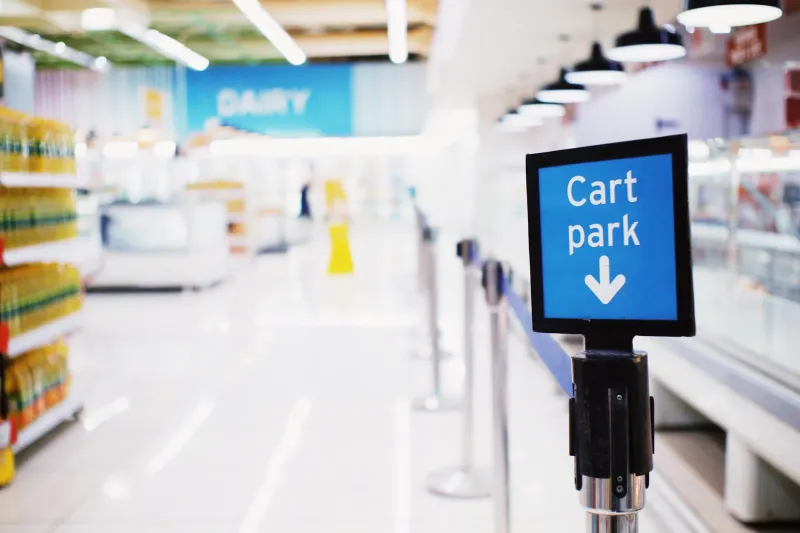
The Unspoken Constitution of Aisle Management
Somewhere between the automatic doors and the produce section, you enter a parallel universe where normal social rules don't apply and everyone becomes a grocery store vigilante. Welcome to the most passive-aggressive 40,000 square feet in America, where the simple act of buying milk can trigger a constitutional crisis.
Nobody handed you the rulebook when you got your first shopping cart, but somehow everyone else seems to have memorized it. These aren't laws—they're something far more powerful. They're the unspoken agreements that keep civilization from collapsing in the cereal aisle.
The Sacred Geography of Personal Space
First rule: the invisible bubble. In normal life, you can stand reasonably close to another human being without triggering an international incident. In the grocery store, that bubble expands to roughly the size of a small aircraft hangar.
Approach someone's cart while they're contemplating Greek yogurt options, and you've committed an act of war. Never mind that there are forty-seven varieties of the same white substance—they need seventeen minutes and complete isolation to make this life-altering decision.
But here's where it gets complicated: you can't just stand there waiting. That's "hovering," which is somehow worse than invading their space. You have to perform an elaborate dance of pretending to examine nearby products while actually conducting surveillance on their decision-making process.
The Cart Abandonment Crisis
Then there's the phenomenon of cart desertion. Someone parks their wheeled vessel in the exact center of the aisle and vanishes into thin air, apparently teleported to another dimension to contemplate soup varieties. Their cart becomes a monument to poor planning, blocking traffic like a overturned semi on I-95.
You approach this abandoned cart with the caution of a bomb disposal expert. Do you move it? Do you squeeze around it? Do you wait for its owner to materialize from the ether? Each option carries social consequences that could haunt you through the frozen foods section.
Moving someone's cart is basically grand theft auto in grocery store law. But trying to squeeze past it guarantees you'll knock something over, creating a domino effect that will somehow result in a pickle jar explosion three aisles away.
The Checkout Line Psychology Experiment
If the aisles are a diplomatic minefield, the checkout area is full-scale psychological warfare. Here's where the real rules emerge, carved in stone by generations of frustrated shoppers:
The express lane is sacred ground. Ten items or fewer doesn't mean "ten items plus or minus five." It doesn't mean "ten types of items." It means exactly ten items, and yes, everyone is counting yours.
That person with twelve items in the express lane? They're not just breaking a rule—they're violating the social contract that holds our entire society together. They know what they're doing. We know what they're doing. The cashier knows what they're doing. Yet somehow, we all participate in this elaborate fiction that maybe they just can't count.
The Divider Politics
And then there's the plastic divider situation—a piece of plastic that somehow carries the weight of international law. Placing the divider is your responsibility as the person behind, but the timing is everything. Too early, and you're rushing them. Too late, and your organic kale is consorting with their energy drinks in a way that makes both of you uncomfortable.
But what happens when there's no divider? Pure chaos. Suddenly, you're both staring at the conveyor belt like it's a crime scene, trying to memorize exactly where your stuff ends and theirs begins. The cashier becomes a referee in a game where nobody knows the rules.
The Produce Section Wild West
The produce section operates under its own separate constitution. Here, touching is not just acceptable—it's required. But there's an art to the touching. You can't just grab the first apple you see. You have to perform the ritual of examination: lift, rotate, inspect, possibly smell, then either select or reject with the gravity of a Supreme Court decision.
 Photo: Supreme Court, via www.flymaxluggage.com
But heaven forbid you take too long. There's a line of people behind you waiting to perform their own fruit forensics, and they're timing you with the precision of Olympic judges.
The Parking Lot Thunderdome
If you survive the store itself, you still have to navigate the parking lot—a lawless wasteland where shopping carts roam free and parking spaces are conquered through a combination of skill, luck, and sheer determination.
The unwritten rule about returning your cart to the designated area is the ultimate test of human character. It's not legally required. No one will arrest you for cart abandonment. But we all know that how you handle your cart reveals your true nature as a human being.
The Beautiful Madness
The most beautiful part of this entire system is that it's completely made up. None of these rules exist anywhere except in our collective consciousness. Yet somehow, millions of Americans navigate this invisible bureaucracy every day, participating in an elaborate social performance that we all pretend is normal.
We've created a complex civilization around the simple act of buying food, complete with unspoken laws, social hierarchies, and moral judgments about produce selection techniques.
And the truly amazing part? It mostly works. Despite the chaos, the passive aggression, and the constant low-level territorial disputes, somehow we all manage to buy our groceries and go home.
At least until next week, when we return to the thunderdome and do it all over again.